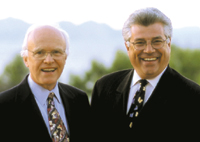
| DHQ: The first edition
of Peopleware, released in 1987, was an overnight bestseller and the second
edition is following at the same pace. How did the book come about and what was
your reaction to its success? LISTER: Peopleware
was born as an experimental session in our "Controlling Software Projects"
seminar, and it just took off from there.
DeMARCO: My first
response was to feel great that we had picked the right subject and nailed it.
But the effect over time of the (almost always grateful) correspondence that has
poured in is quite different. The stories those letters tell are individually
amusing and collectively depressing. I have been so privileged to work over the
years under talented and humane managers; I'm full of sympathy for those who have
gotten less of a good break. DHQ: Is there a unifying
theme to the eight new chapters in Part VI, Son of Peopleware? How do the
new chapters relate to the originals? LISTER:
I'd say it is the change from workplace to community. Most people these days look
to work to find all sorts of fulfillment I never thought about as a young programmer.
They look to the job to find friendship, enjoyable social functions, even love. DHQ:
Is there a ceiling to the amount of freedom that management can give a programming
team before the team loses control of itself? If so, what is that point?
DeMARCO: The hardest and most useful trick of management is to
know not to steer when the project is going in the right direction. Of course
this applies as well to the project that is going in almost the right direction.
The team has an innate ability to steer itself and you need not to intervene unless
it really has begun to wander off track. DHQ: If
you could pick one insight from Peopleware to broadcast to every software
development manager, what would it be? DeMARCO:
It's the idea that good managers are talented and adept at building real community.
LISTER: I'd add that people really yearn to do good work. If
you manage them any other way, you are participating in some sort of dysfunction. DHQ:
You two have been a jelled team for many years now. What's your secret?
DeMARCO: There is an element of luck in our pairing. Decent jell
requires lots of respect, shared values, good emotional connection, and at least
some similarity in sense of humor. But those things aren't enough. I think it's
also important that teammates have some clearly complementary skills. I am constantly
aware that Tim's contributions are in domains where I do not excel. He is a gifted
phrasemaker, quipper, image coiner, and a genuinely original thinker. We also
have some domains in common: We're both very serious about being in the abstraction
business. We both know that a good abstraction is worth many days of work. It's
the combination of some overlapping skills and some complementary skills that
has been essential for us.
LISTER: Like every happy couple,
we work together often, but also go our separate ways at times. Tom never even
told me he was writing The Deadline. A manuscript appeared one day; I read it
in one sitting. It was like a present, even if it wasn't just for me. DHQ:
Peopleware is celebrated for promoting management concepts that are controversial
within the computer industry. How have the debates you've raised affected you
over the years? DeMARCO: I find I'm not so
welcome anymore in companies that make a practice of burning out their workers.
High pressure managers are threatened by the thought that there are limits to
how much good applying pressure can do. Yet pressure has some very pronounced
limits. Consider this: If you tell a joke in front of an audience and hold up
a laugh sign, people will dutifully laugh—even if your punch line wasn't
terribly funny. But if you leave that sign up for more than about five seconds,
the laughter will die away and leave you with a cold, sullen silence. I'd like
to put all new managers on a stage and make them perform that experiment enough
times to know what cold, sullen silence sounds like. Then they will recognize
it the next time they try to apply too much pressure.
LISTER:
I don't think this is exactly trouble, but somehow I've been dubbed a workspace
expert. I've even been on a panel at a meeting of the Royal Canadian Society of
Architects. If you think a lot of office space is poor, you should have heard
the air quality expert that night! DHQ: Instead of
revising all the chapters of the original text, you added a whole new section
with eight chapters. What were your impressions of the original text as you prepared
the second edition? DeMARCO: The French author
Marcel Pagnol was asked to prepare a revision of a book he had published many
years before. He sketched out some ideas and then stopped, and finally sent the
unchanged original back to the publisher with a note saying, "I no longer
have the right to make changes to this young writer's work." DHQ:
In Peopleware terms, what have been the healthiest and sickest trends of
the last ten years? DeMARCO and LISTER: Healthy:
small empowered teams, co-location, lots of job formation in new companies with
no institutional baggage. Not so healthy: level envy, process obsession, most
"team building exercises," distributed "teams," and Management
by Objectives. DHQ: What evidence have you seen that
the industry is moving in the direction of the Peopleware principles?
DeMARCO: First of all, the term Peopleware is in general
use everywhere. Even people who don't know what it means realize that it is one
of every manager's chief responsibilities. I think the strongest Peopleware
theme that is actively at play in business today is an understanding that keeping
people is the sine qua non of success. On the downside, we clearly didn't win
the sensible workplace war. Companies presented with evidence that noise and tight
quarters are counterproductive just close their eyes and ears and proceed as before. DHQ:
Thanks, Tom and Tim! |